

What you need to know about a virtual phone number
Understand how a virtual phone number receives and forwards calls, and when it can help you stay in touch locally.

wp:html
This is a translation of an earlier article. Prices, coverage, promotions and application screens reflect the original publication and may have changed. Check current availability, requirements and rates before ordering.
Virtual telephone: things you should know
Whoever is thinking about ordering a virtual telephone should know some aspects about this service to determine if it is a solution adapted to their needs or if, on the contrary, it is not the solution they need.
Having a virtual phone can be extremely useful on many occasions and on many others it may not really be the service that is needed, so it is good to know how it works to be aware of everything it includes and be able to make an informed decision.
Unpacking the virtual phone
When we are talking about a virtual phone, we can actually be talking about different services, but in the case at hand here we will focus on one of them. In this article we will focus on the virtual telephone number.
A virtual phone could be a telephone number or a calling service over the Internet, what is called a telephone that works over an IP, or what is the same, we could be talking about VOIP telephony but we are not talking about it.
In the same way as what was expressed in the previous paragraph, we could also be talking about a virtual PBX or similar services, but in this case, for this specific service, we are not talking about it either.
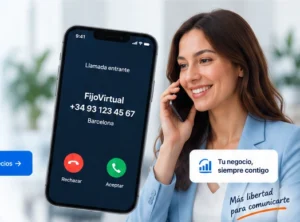
For the case at hand here, everything is much simpler, everything is much easier and simpler. In the case that concerns us here, we are talking about the possibility of having assigned as many virtual telephone numbers from any place as are needed to be able to receive the call on them but for the call to ring on any other device where the call is forwarded.
Thus, a virtual phone, in the terms discussed in this article, is not a phone that necessarily requires a switchboard or from which we can connect to the Internet or anything like that. A virtual phone in the terms discussed in this article is a number that allows us to provide local service or receive calls of any type as if we were local without actually having to be local or be in the place.
Thus, for example, any student who arrives at a certain place can choose a local telephone number for that place (in the case of, for example, Spain, a number from the province they want) and from that moment have the calls they receive there diverted to any other landline or even to their mobile phone, and be able to comfortably receive calls without the need to have any infrastructure enabled in this regard.
This also benefits the people calling your virtual number. They can dial a number local to them rather than an international destination. Their own provider determines the charge, while forwarding is billed under your service plan. This arrangement can make staying in touch more convenient and may reduce costs.
Ordering is straightforward and completed online. Check the available numbers, the monthly fee and the forwarding costs to choose a service that suits your needs.
Explore virtual numbers · Check countries and prices
/wp:html